
How soon can I use silicone scar sheets after surgery?

If you have just had surgery and bought silicone scar sheets, the big question is often: “How soon can I use them?”
There is no single magic day for everyone. Most surgeons and scar-care guidelines agree on this rule:
Start silicone scar sheets only after the incision is fully closed, dry, and cleared by your surgeon – often around 1–3 weeks after surgery, but it varies.
This guide explains the timing in more detail so you can understand the reasoning and know what to ask your doctor.
1. Quick guide: when do most people start silicone scar sheets?
Different clinics give slightly different numbers, but when you look across plastic-surgery practices and hospital instructions, a pattern appears.
General rule: start when the wound is fully epithelialized (a new layer of skin has grown), there is no scab, no drainage, and stitches or staples are out.
They work by creating a semi-occlusive, hydrated environment over the scar, helping regulate collagen and flatten raised scars. If you want a deeper dive into the science and benefits, see our in-depth guide to silicone scar therapy.
Typical timeframes (approximate):
| Situation | Common range doctors quote* |
|---|---|
| Small, uncomplicated incisions | About 1–2 weeks once the surface is sealed |
| Larger body / breast surgeries | About 2–3 weeks after surgery, once sutures are out and incision looks dry |
| Some plastic-surgery protocols | Sometimes 5–7 days if the incision has already sealed and the surgeon specifically allows it |
| If wound healing is slow or there were complications | Start later, only after your surgeon approves |
*These are averages taken from surgeon FAQs and scar-care leaflets, not rigid rules.
If you had a complication (infection, wound separation, drainage, delayed healing, diabetes, smoking, etc.), your safe start date is often later than average, and only your own doctor can set it.
2. Why you shouldn’t put silicone scar sheets on too early
Silicone scar sheets are designed for closed skin, not open wounds.
They work by creating a semi-occlusive, hydrated environment over the scar, helping regulate collagen and flatten raised scars.
Putting them on too early can cause problems:
- They can trap moisture and bacteria over an open or weeping wound.
- They may loosen Steri-Strips, glue, or fresh scabs that are still helping the incision close.
- Friction from removing and re-applying the sheet can pull at fragile edges.
That is why many surgeons and guidelines say “wait until it’s healed” rather than giving a fixed day.
3. Use healing checkpoints, not just days on a calendar
Instead of counting exact days, check these healing checkpoints with your surgeon or nurse.
You are usually ready to consider silicone scar sheets when:
- No open areas. The incision line is fully closed; no gaps and no raw tissue.
- No scabs or crusts. Any scabs have naturally fallen off; you are not picking them off.
- No drainage. No blood, clear fluid, or pus coming from the incision.
- Stitches, staples, or Steri-Strips are removed (unless your surgeon gives different instructions).
- Skin looks like “new skin,” not an open wound. It may still be pink or red, but it has a continuous surface.
- No active infection. No spreading redness, hot area, pus, or fever.
If any of these are not true, it is too soon—even if the calendar says “two weeks.”
4. What different sources say about “how soon”
When you read surgeon FAQs and scar-care leaflets, you’ll see timing described in slightly different ways:
-
Plastic surgeons on forums and clinic websites:
Many say that once the wounds are fully healed—often around 2–3 weeks—they encourage patients to start moisturizing and silicone therapy, then continue for 4–6 months. -
Consumer health and hospital instructions:
Often recommend starting silicone when incisions are completely healed and sutures removed, “normally” about 3 weeks post-op. -
Some breast/body surgery protocols:
Mention that silicone sheets may be applied to incisions 5–7 days after surgery, worn 20–24 hours a day, if the incisions are sealed and the surgeon gives the go-ahead. -
Scar maturation focus:
Other resources emphasize the scar-remodeling phase (about 6–8 weeks after surgery) as an important window where silicone is especially useful, even though it can start earlier once the skin has closed.
The common theme is that timing is tied to wound-healing status, not just the number of days since surgery.
5. Does timing change with surgery type?
Yes. The basic rule (closed, dry, no stitches) is the same, but different procedures heal at different speeds.
5.1 C-section, tummy tuck, and body contouring
- Incisions are long and on areas that move a lot.
- Many surgeons wait 2–3 weeks until the incision is well sealed and any drainage has stopped.
- Some start silicone earlier on small, well-healed sections while other areas catch up.
5.2 Breast augmentation, reduction, or lift
- Protocols vary widely.
- Some plastic surgeons use paper tape for the first 3 weeks, then switch to silicone sheets after that.
- Others introduce silicone as soon as stitches are removed and the skin is intact.
5.3 Thyroid and neck surgery
- Neck incisions are relatively small but exposed to a lot of movement and sun.
- Once the glue or Steri-Strips come off and the line is smooth, surgeons may allow silicone as early as 1–2 weeks, but many prefer to review the scar at a follow-up visit before starting.
5.4 Minor skin surgery and mole removal
- Small lesions can close faster, sometimes within a week.
- Some dermatology and cancer centers allow silicone sheeting soon after the first follow-up, once the site is closed and sutures are out.
Again, the exact date is less important than what the scar looks like and what your surgeon says.
6. How to start silicone scar sheets safely
Once your provider says “yes, you can start,” follow a slow, gentle ramp-up like many hospital leaflets recommend.
-
Patch-test first
Cut a small piece of the sheet and wear it on or near the scar for 2–4 hours. Check for itching, burning, or rash after you remove it. -
Increase wear time gradually
Day 1–2: 2–4 hours/day
Day 3–4: 4–8 hours/day
After that: build up to 12–24 hours/day as tolerated (many products recommend at least 12 hours daily). -
Clean skin, clean sheet
Apply to clean, dry, lotion-free skin so it sticks well and does not trap extra oils. Wash the sheet as the manufacturer instructs to avoid irritation and loss of adhesion. -
Watch your skin
Mild redness or imprint marks that fade quickly can be normal. Persistent redness, blisters, or itching mean you should take a break and contact your provider.
Once your incision is healed and you are cleared to start silicone, the next question is how many hours per day and how many weeks you should continue. We break this down step by step in our companion article, a full guide to silicone scar sheet wear time
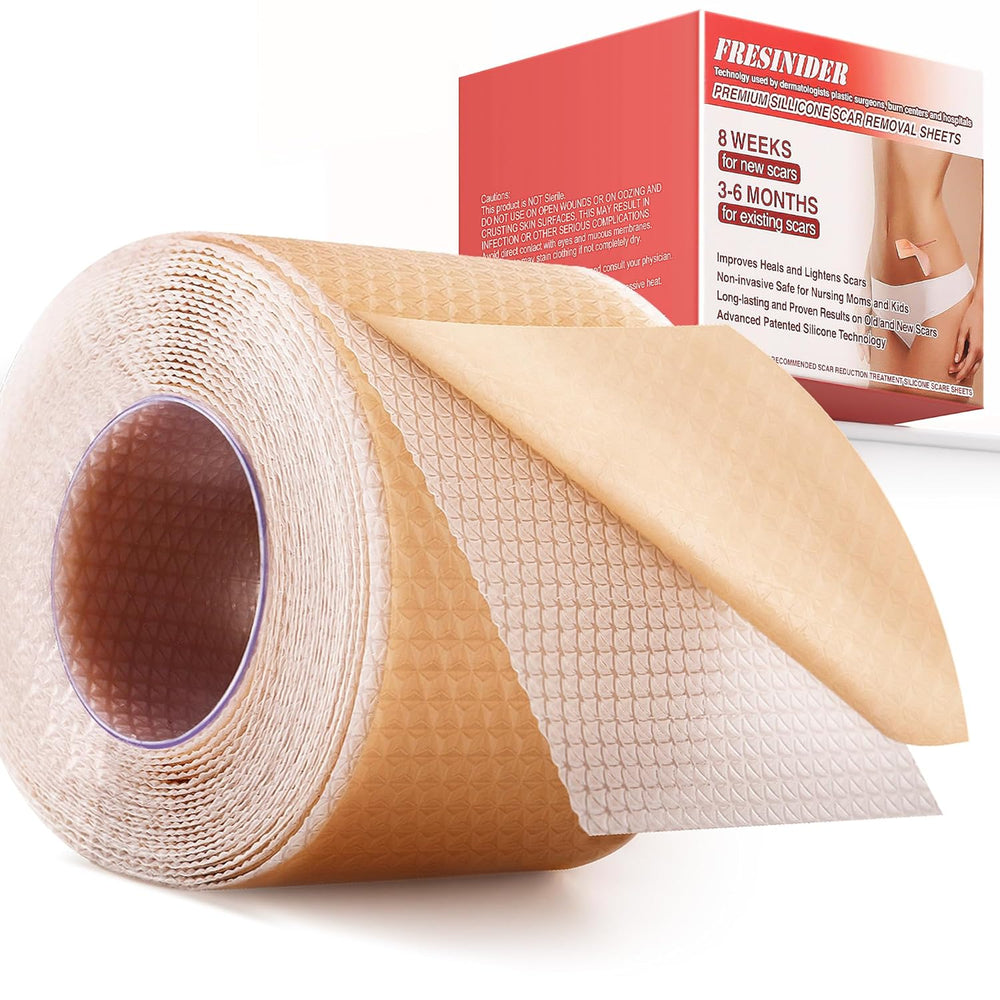
FRESINIDER Silicone Scar Sheets
- Medical-grade silicone — soft, breathable, skin-friendly
- Cut-to-fit & reusable — comfortable under clothing, even overnight
- Helps soften, flatten, and reduce redness & itch over time
- Ideal for C-section & surgery scars; easy daily care at home
Comfort-first scar care trusted by moms & post-surgery users.
7. What if your scar is already old?
If your scar is fully healed and months or years old, you can normally start silicone sheeting right away (assuming your skin is intact and not irritated).
Research suggests silicone can still help soften and flatten older hypertrophic scars, though results are usually better on newer scars.
Realistic expectations:
- New scars (within the first year): often respond with visible softening and color changes.
- Older scars: may still improve in texture and itch, but changes are slower and more modest.
8. FAQs about when to start silicone scar sheets
Q1. Can I put silicone sheets over Steri-Strips or glue?
Usually no. Steri-Strips and skin glue are still part of wound closure. Most surgeons prefer to let those come off first, then start silicone on the healed line beneath—unless they explicitly tell you a different plan.
Q2. What happens if I start too early?
If you place silicone over an incompletely healed wound, you increase the risk of:
- Trapping moisture and bacteria, which can lead to infection.
- Softening or loosening the edges, leading to wound breakdown.
- Painful removal and damage to fragile new tissue.
If this happens, stop using the sheet, let the area air and heal, and contact your surgeon.
Q3. Is it “too late” if I wait a few months?
Not necessarily. Silicone is most effective in the first months after surgery during active scar remodeling, but it can still help older scars. It may just take longer and the changes may be subtler.
Q4. My friend started at 1 week, my doctor says 3 weeks. Who’s right?
Both can be right for their own situation. Your surgeon knows:
- How deep and long your incision is.
- Whether you had any complications.
- Whether you have risk factors that slow healing.
It is always safer to follow your own surgeon’s protocol, even if it seems later than what you read online.
9. Key takeaways
- The right time to start silicone scar sheets is when your incision is fully closed, dry, and cleared by your surgeon.
- For many people, this ends up being around 1–3 weeks after surgery, but it can be earlier or later depending on the procedure and how you heal.
- Focus on healing checkpoints: no scabs, no drainage, no stitches, no open areas.
- Start slowly, build up wear time, and continue silicone for several months for best results.
- When in doubt, show your scar to your surgeon or nurse and ask directly: “Is my incision healed enough to start silicone scar sheets now?”